
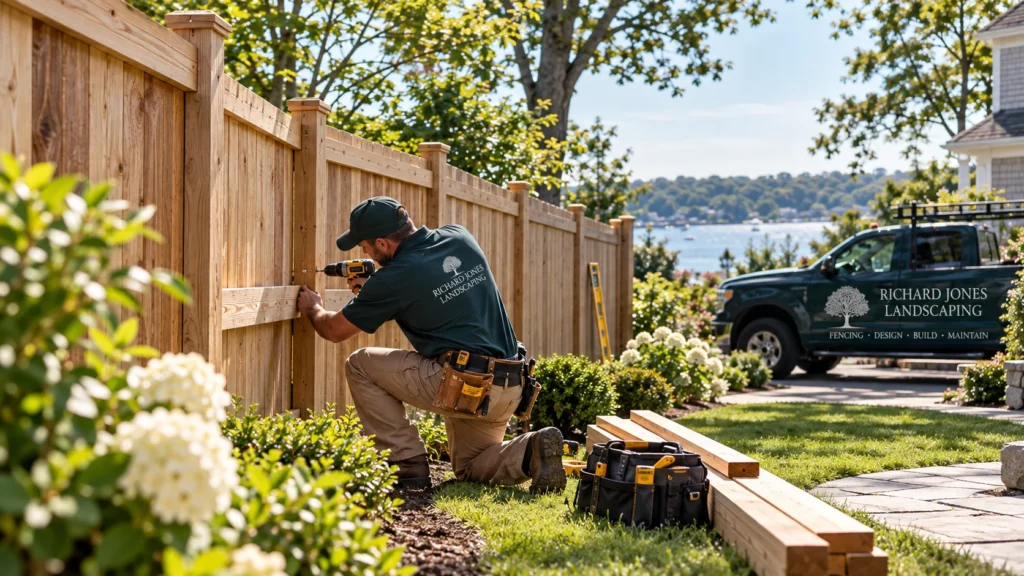
Repair a fence when the damage is limited and the posts are still solid. Replace it when the posts are rotting or leaning, when damage is widespread, or when you keep paying for repairs that don’t last. Posts are the deciding factor, because a fence is only as sound as what holds it up.
Most fences in Fairfield County show wear after years of freeze-thaw cycles, heavy snow and humid summers. The question is whether a fix will buy you real time or just delay a bigger bill. Below you’ll find the warning signs, a simple way to decide, and what replacement involves. If you’re weighing materials for a new fence, our cedar vs. pressure-treated guide can help.
Which fence problems can be repaired?
This table shows the common problems and whether a repair usually makes sense.
| Problem | Repair or replace? | Why |
|---|---|---|
| A few cracked or loose boards | Repair | Individual boards are simple to swap, and the structure is still sound |
| Fading or graying finish | Repair | Cleaning and refinishing restores the look without structural work |
| A sagging gate | Often repair | Hinges, latches, or a brace can fix it, unless the gate post has moved |
| One leaning post | Depends | One post may be reset, but ask why it leaned in the first place |
| Several leaning posts | Replace | Usually points to failing footings or ground movement along the line |
| Rot at the base of posts | Replace | Rotted posts can’t hold the fence and the problem spreads |
| Soft, spongy or crumbling wood | Replace | The wood has lost its strength |
| Widespread warping or splitting | Replace | Boards are no longer holding their shape |
What are the signs it’s time to replace a fence?
A few warning signs point toward replacement rather than another patch:
- Posts that wobble, lean, or heave. If you can push a post back and forth, the footing has likely failed.
- Rot at or below ground level. Poke the base of a post with a screwdriver. If it sinks in easily, the wood is decayed.
- Damage along much of the fence line. When problems show up in many sections, the whole fence is aging out together.
- Repeated repairs. If you fix one section and another fails a few months later, you’re likely chasing a bigger problem.
- Gates that won’t hold. A gate that keeps dropping often means the gate post or surrounding fence has shifted.
- A fence that no longer does its job. Gaps for pets, lost privacy, or safety concerns around a pool all matter more than appearance.
A fence that’s more than a decade or two old, depending on the wood and the care it’s had, is also worth a professional look even if it seems fine.
Is there a simple rule for deciding?
Many contractors use a rough guide: if a third to a half of the fence needs work, replacing the whole thing usually makes more sense than patching it. It’s not exact, but it keeps you from spending money repeatedly on a fence that’s near the end of its life.
The condition of the posts matters more than the percentage. Boards are easy and inexpensive to swap. Posts are the structure. If they’re sound and straight, a fence with tired boards can often be repaired or re-boarded. If they’re rotted or moving, new boards just sit on a failing frame.
For wood fences in Connecticut, post problems are very common because of frost heave and wet soil. We cover that in more detail in our cedar vs. pressure-treated guide.
How should I think about the cost of repair vs. replacement?
Repair costs less today. Replacement costs more today but may cost less over time. The better comparison is what you’ll spend over the next several years, not just this season.
A few things to weigh:
- How long the repair will last. A new board lasts as long as the posts beside it do.
- How many repairs you’ve already made. A pattern of repairs is a sign that spending more on the old fence has diminishing returns.
- What else you plan to do. If you’re redoing the landscaping, patio, or driveway, replacing the fence at the same time can save disruption and rework.
- Your property’s needs. Fences that protect pets, children, or pools should be reliable, not patched.
Prices vary with the length of the fence, the material, grade, access, and the number of gates, so the most useful step is to click here for a site visit and a written estimate.
What does fence replacement involve?
Replacing a fence is more than swapping boards. A typical project includes:
- A site walk. We look at the existing fence, grades, access, gates, and nearby plantings.
- Removal of the old fence. This includes posts, footings, and debris.
- A fresh layout. Replacement is a chance to correct problems, like a line that sat too close to a tree or a gate in an awkward spot.
- New posts and footings. Set deep enough for local frost conditions, with drainage in mind.
- Installation and a final walkthrough. Boards, gates, and hardware go in, and the site is cleaned up.
One thing homeowners often assume is that a replacement fence needs no approval because there’s already a fence there. That isn’t always true. Height, location, or material may be treated differently under current rules, and your property may have changed since the original was built. Check with your town before you start. Our fence permits guide explains what to ask.
Should I upgrade when I replace my fence?
A replacement is the best time to fix what never quite worked. Common upgrades include:
- A more durable material or better post setup
- Gates moved to where you actually walk, drive, or bring equipment
- A different style, such as more privacy around a patio or a more open look elsewhere
- Plantings that soften the fence line and screen it from the street
- A stone or masonry base or entry feature that ties the fence to the house
Our team can coordinate landscape design, plant installation, and masonry and hardscaping around the new fence, so the finished property feels designed, not patched together. You can see examples in our project gallery.
Frequently asked questions
How do I know if my fence needs to be replaced?
Look at the posts first. Posts that lean, wobble, or are rotted at the base usually mean replacement. Widespread damage or repairs that keep failing point the same way.
How long does a wood fence last?
A wood fence commonly lasts about 10 to 30 years, depending on the wood, installation, and upkeep. Cedar tends to last longer than pressure-treated pine in many conditions.
Can I replace just part of my fence?
Often yes, if the posts in that section are sound and the rest of the fence is in good shape. If damage is spread across the fence, partial replacement may only delay a full one.
Can a leaning fence be fixed?
Sometimes. A single leaning post may be reset or braced. If several posts lean, the footings or the ground are usually the problem, and replacement tends to be the lasting fix.
Do I need a permit to replace a fence in Connecticut?
It depends on your town and the project. Rules on height, location, and materials can apply even to a like-for-like replacement, so check with your zoning office first. Our fence permits guide covers what to ask.
What’s the best time of year to replace a fence?
Fences can be installed in most seasons, but ground conditions matter. Frozen or saturated soil can slow work, so ask about timing when you request an estimate. [CONFIRM AND EDIT: add your own seasonal scheduling notes.]
Not sure whether to repair or replace?
Richard Jones Landscaping has served homes and estates across Fairfield County since 1985, including Greenwich, Darien, and New Canaan. Our fencing services include removal and replacement of aging fence sections or complete fence lines, along with new wood privacy fencing, decorative fencing, pool-area fencing, and gates. We’ll look at the posts, the grade, and the condition of the whole fence, then tell you plainly what makes sense. To keep the property looking its best afterward, our estate property management service handles year-round care.
Request a free fencing estimate or call 203 588 0038.
Every fence and property is different. This article is a general overview. Always confirm local requirements with your town before you build or replace a fence.