
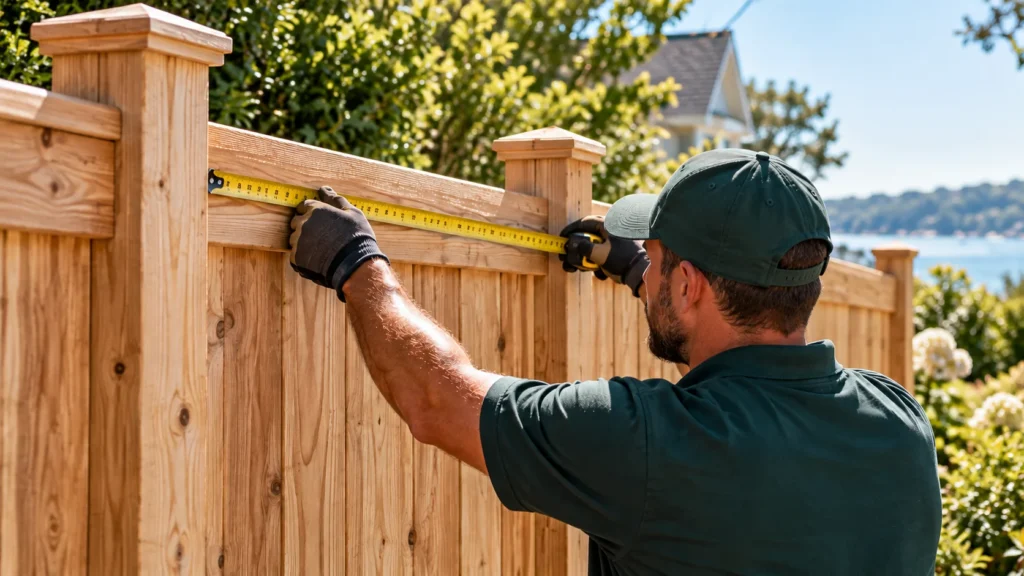
If you’re thinking about a new fence for a home in Greenwich, Darien, New Canaan or anywhere nearby, you’ve probably noticed that most of the advice online was written for a small suburban lot in some other part of the country. Properties here are often larger, more wooded, more sloped, and more closely regulated, and the winters are hard on anything left outside.
This guide covers what actually matters when you plan fence installation for a property in Fairfield County: which styles fit which jobs, how the common materials hold up, what your town may require, what good installation looks like, and how to keep a fence in shape for years. Where a topic deserves more room, we link to a deeper article. You can read straight through or jump to whatever you need.
Why does fencing matter on a larger property?
On a big property, a fence is rarely just a boundary. It usually has several jobs at once:
- Privacy. Screening a patio, pool, or garden from neighbors or from the road.
- Safety. Keeping children and pets inside the yard and meeting safety needs around a pool.
- Definition. Marking where one part of the property ends and another begins, from the driveway entrance to the back acreage.
- Protection for plantings. Keeping foot traffic and animals out of gardens and landscaped areas.
- Curb appeal. A well-chosen fence adds to the look of the house and grounds. A poor one detracts from it.
Because one fence often has to do more than one of these things, it helps to decide what matters most before you choose a style or a material.
What fence styles work best for Fairfield County homes?
The right style depends on the job the fence has to do and the character of the property. These are the ones we see most often.
| Style | Privacy level | Best for |
|---|---|---|
| Solid board privacy fence | High | Pools, patios, backyards near roads or close neighbors |
| Board on board | High | Full screening that stays private as the wood shrinks |
| Shadow box | Medium to high | Windy spots, or a fence that looks good from both sides |
| Spaced or semi-private | Medium | Larger properties where a closed fence would feel heavy |
| Decorative and property-defining | Low | Marking boundaries, framing gardens, entry and driveway areas |
| Pool-area fencing | Varies | Safety around pools, with specific requirements to follow |
| Gates | Varies | Driveways, garden entries, service access and pool enclosures |
A few things tend to guide the choice. Fully solid fences give the most privacy but can feel closed in on a large lot and catch more wind. Open and semi-private styles keep views and light. Along a street frontage, towns often treat height and solidity differently than they do in a back yard, so the style you want may not be the style you’re allowed. See the rules section below.
You can see finished examples in our project gallery, or learn more about our fencing services.
Which fence material holds up best in Connecticut?
Connecticut weather is demanding. Snow and ice, spring rain, humid summers, and repeated freezing and thawing all work on a fence. Wood is the most common choice for residential privacy and decorative fencing here, and the two woods people usually compare are cedar and pressure-treated pine.
Cedar costs more up front, resists rot and insects naturally, and tends to stay straighter. It can be left to weather to a silver gray or finished to keep its color. Pressure-treated pine costs less and takes paint and stain well, but it usually needs more upkeep and can shrink or twist as it dries. Many fences use pressure-treated posts with cedar boards, since the posts take the most abuse from ground moisture.
We compare both in detail, with lifespans, upkeep, and finish options, in our cedar vs. pressure-treated guide.
Whatever the material, the installation matters just as much. Posts set too shallow will heave in winter no matter how good the boards are.
What rules apply to fences in Fairfield County?
Connecticut doesn’t have one statewide rule for residential fences. Each town sets its own through its zoning regulations, so what applies in Greenwich can differ from Darien or New Canaan.
The topics that come up most often are:
- Height limits, which often differ between front, side, and rear yards
- Setbacks from property lines and roads
- Restrictions on materials or solid fencing near the street
- Extra rules for pool fencing
- Review for work near wetlands, watercourses, or flood zones
- Local historic district review in some neighborhoods
- HOA approval where one applies
Larger properties are more likely to include wetlands or steep, wooded ground, so it’s worth asking early. Also confirm where your property line actually runs, and call 811 before any digging.
We walk through all of this, with a checklist of questions to ask your town, in our fence permits guide.
What does good fence installation look like?
Most fence failures start at the posts, not the boards. In Connecticut, the ground freezes and thaws every winter, and a post set too shallow can heave or lean as the soil moves. Heavy clay, poor drainage, and sloped ground make it worse. Good installation deals with all of this up front.
Here’s what to look for in a contractor:
- Posts set below the frost line with solid footings, and drainage planned where the soil needs it
- Sturdy gate posts, since gates carry the most stress
- A site visit before the quote, not an estimate from a phone call
- A written estimate that names the materials, the fence height and style, the number of gates and who handles cleanup
- Clear answers about permits, property lines, and utility marking
- Proof of licensing and insurance, plus photos or references from similar projects
Questions worth asking before you sign:
- How deep will the posts go, and how will you set them?
- Who is responsible for permits and approvals?
- How do you handle slopes, trees and wet areas along the fence line?
- What does the warranty cover, and for how long?
- What happens to the old fence if this is a replacement?
How do I maintain a fence through the seasons?
A wood fence doesn’t need much, but it does need something. A short check each season catches small problems before they turn into replacements.
| Season | What to do |
|---|---|
| Spring | Walk the fence line after the thaw. Look for leaning or heaved posts, loose boards and gate sag. Clean off winter grime and mildew. |
| Summer | Refinish or reseal if the wood is due, once it’s fully dry. Trim plants and vines back so air can move around the fence. |
| Fall | Clear leaves and debris from the base. Check hardware, hinges and latches. Make repairs before the ground freezes. |
| Winter | Avoid piling snow against the fence. Keep salt and plow spray away from the wood where you can. |
Two habits make the biggest difference. Keep soil, mulch, and plantings from touching the bottom boards, because trapped moisture shortens a fence’s life. And fix small issues early, since one loose board or one leaning post often points to a larger problem.
When should I repair a fence and when should I replace it?
If the damage is limited and the posts are still solid, repair usually makes sense. A few cracked boards, a tired finish or a sagging gate are all fixable. If the posts are rotting or leaning, if damage runs along much of the fence, or if you keep paying for repairs that don’t last, replacement is usually the better move.
The posts decide it. Boards are easy to swap, but posts are the structure, and new boards on a failing frame won’t hold. Many contractors suggest replacing the whole fence once a third to a half of it needs work.
Our repair or replace guide has a problem-by-problem table, the warning signs to watch for, and what replacement involves. If you do replace, it’s also worth checking whether your town treats the new fence differently from the old one, as covered in the permits guide.
How does a fence fit into year-round property care?
A fence doesn’t stand alone. It sits among plantings, lawns, drives and patios, and what happens around it affects how long it lasts and how it looks. Overgrown shrubs trap moisture against the boards. Mulch piled at the base invites rot. Grading and drainage decide whether posts stay put through the freeze-thaw cycle.
That’s why we like to plan fences together with the rest of the property. Our team handles landscape design, plant installation, and masonry and hardscaping, so the fence, the plantings, and the stonework are designed to work together instead of being fitted around one another later.
After the fence is in, our estate property management service can include the seasonal checks, trimming, and cleanup that keep it in good shape.
Frequently asked questions
Do I need a permit to build a fence in Fairfield County?
Often, but it depends on your town and property. Connecticut has no single statewide fence rule, so zoning regulations in each town apply. Our fence permits guide explains what to check.
What is the best wood for a fence in Connecticut?
Cedar is a popular choice because it resists rot and insects and stays fairly straight through freeze-thaw cycles. Pressure-treated pine is a lower-cost option that needs more upkeep. See our cedar vs. pressure-treated guide for a full comparison.
How long does a wood fence last?
Roughly 10 to 30 years, depending on the wood, how well it was installed and how well it’s maintained.
What type of fence gives the most privacy?
Solid board and board-on-board fences give the most privacy. Shadow box and spaced styles offer partial screening with more light and airflow.
How do I know if I should repair or replace my fence?
Look at the posts. If they’re sound, repairs often work. If they’re leaning or rotted, or damage is widespread, replacement is usually better. Read our repair or replace guide for details.
What does it cost to install a fence?
It varies with the length, height, material, grade, access, and number of gates. A site visit and written estimate is the only reliable way to get a number.
Can you install a fence around a pool?
Yes, though pool fences follow specific safety requirements, so check with your town early.
Ready to talk about your fence?
Richard Jones Landscaping has served homes and estates across Fairfield County since 1985, including Greenwich, Darien, New Canaan, Stamford and Westport. Our fencing services cover wood privacy and semi-private fencing, decorative fencing, pool-area fencing, gates, and removal and replacement of old fences.
We’ll walk your property, talk through styles and materials, and give you a clear written estimate. If the fence is part of a bigger project, we can plan it with the rest of your landscape from the start.
Request a free fencing estimate or call 203 588 0038.
Rules, costs and conditions vary by town and property. This guide is a general overview, not legal advice. Always confirm local requirements with your town before you build.